Products exported to Europe may soon need a digital product passport
Products exported to Europe may soon need a digital product passport
If your business exports products to Europe, a significant regulatory change is coming that could affect how you manage and share product information.
The European Union has introduced a Digital Product Passport (DPP) initiative, designed to improve product transparency, sustainability, and traceability. Over the coming years, many products sold into the EU market will be required to have a Digital Product Passport - a digital record containing information about a product's origin, materials, environmental impact, compliance, repairability, and end-of-life handling.
“The Digital Product Passport (DPP) will become the main tool for disclosing and sharing product information across all new and revised product legislation.” - The European Commission.
While this legislation originates in Europe, its impact will be global. New Zealand manufacturers, brand owners, exporters, and retailers supplying products to the EU should start preparing now.
What is a Digital Product Passport?
A Digital Product Passport (DPP) is a digital record that contains detailed information about a product's entire lifecycle including the product’s:
Technical performance
Materials and their origins
Repair activities
Recycling capabilities
Lifecycle environmental impacts.
Powering the Digital Product Passport with GS1 standards
The Ecodesign for Sustainable Products Regulations establishes a framework of requirements for DPPs including traceability, transparency, and accessibility.
GS1 standards can directly support these requirements by leveraging global identifiers such as Global Trade Item Numbers (barcode numbers) for product identification and Global Location Numbers for facility identification. GS1 members will be able to use QR Codes powered by GS1 to enable the Digital Product Passport to be easily shared.
See below for an example of a Digital Product Passport.
 What products are affected?
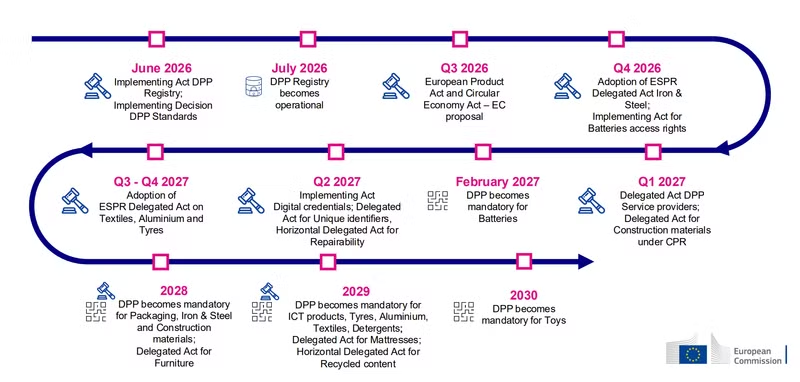
Some product categories are exempt such as food, feed and medicinal products. The list of prioritised product categories that will be required to have a Digital Product Passport are:
Iron and steel
Aluminium
Textiles, in particular garments and footwear
Furniture, including mattresses
Tyres
Detergents
Paints
Lubricants
Chemicals
Energy related products
Information and communication technology products and other electronics.
 What do I need to do?
Although many DPP requirements are still being finalised, now is the time to prepare.
If you’re exporting products to Europe we recommend you:
Ensure your products have unique identifiers e.g. GTINs
Understand what the export requirements are for your product sector or category
Select the data carrier you’ll use to share your Digital Product Passport e.g. QR Codes powered by GS1, Near Field Communication (NFC) chips or Radio Frequency Identification (RFID).
Prepare your data readiness and availability to meet the requirements. (Tip: Requirements often require proof or chain of evidence or tracking/traceability data).
Book a free consultation with us to find out more about QR Codes powered by GS1.
Useful links
Ministry of Foreign Affairs and Trade
This article featured in: