Over 500,000 products moved into improved MyGS1 Member Portal!
From creating a new product to generating a barcode graphic, our digital services are an important part of how many members engage with GS1 New Zealand.
Over the past year, we’ve been making improvements to how our services are delivered digitally with a simple aim in mind - make our services more intuitive and seamless to use.
Our digital product roadmap
Our digital product roadmap guides the improvements we’re making and is focused on what members have shared they need from our services.
There are four main areas we’re working on: bringing GS1 services together in MyGS1, creating a more consistent experience across our products, making them easier to use, and making it simpler to access and share data.
Over the past year, we’ve made good progress across these areas.
Improved MyGS1 member portal
If you’ve migrated across to the improved MyGS1 member portal, you’ll have noticed a new look and a much simpler way to set up and manage your products.
For the past year, we’ve been progressively migrating members and products from the legacy MyGS1 portal to the new portal. A big part of this work has been moving barcoded product data from Product Vault into the Allocated Barcodes module in MyGS1. Eddie Guinness, a Product Owner at GS1 New Zealand, has been leading the migration programme: “This has been a major piece of work over the past year. We’re nearing the end of the migration project and that’s exciting for us because more of our members will have an improved experience. We’ve been hearing positive feedback from members using the new platform, which is great.”
MyGS1 migration by the numbers
Around 90% of members have now moved from the legacy MyGS1 to the new platform, bringing more than 500,000 products across with them!
MyGS1 allows core product data (Global Trade Item Number, brand, Global Product Classification (GPC), description, net content and unit of measure (UoM), country of sale, and image link) to be sent automatically to the Global Registry Platform. This registry, with ~1 billion products in it and growing at 120m per year, is currently supporting 40m queries per day from search engines, AI, marketplaces, retailers, regulators and border protection agencies. Brand owners, assuming they don't want to hide their product from the market, should have a keen interest in getting their ‘product passports’ accurate and with a product image to ensure that prospective buyers can see their products.
In the financial year ended 31 August there were 539,397 products sent to Verified by GS1, making them easier to find by consumers searching the web.
Next to be migrated to the new platform are GS1 New Zealand members based overseas, including those in Fiji, Tonga and other Pacific Islands.
Finding your GS1 services is getting easier
We’ve heard from members that navigating between different GS1 New Zealand services hasn’t always been easy – and that is has sometimes been difficult to know who within your organisation had access to each GS1 service.
We’ve made changes to MyGS1 to address this.
You can now see your GS1 services more easily from within MyGS1, navigation between services is clearer, and you can see which people in your organisation have access to each service. 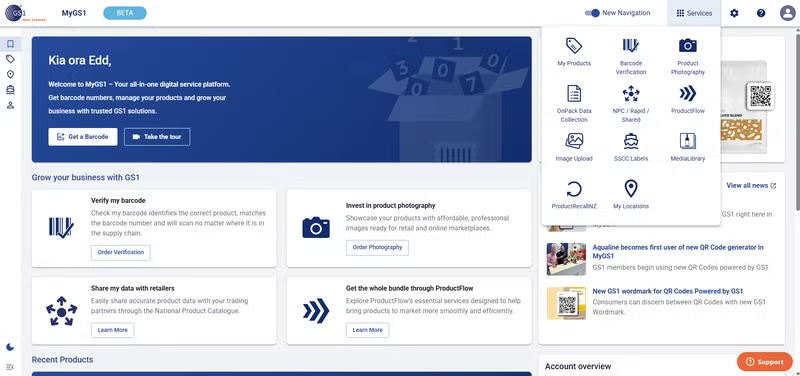 An easier way to create GS1 2D barcodes
We’ve also been making it easier for members who are starting their move to GS1 2D barcodes.
In December 2025, we launched a QR Code powered by GS1 generator in MyGS1. Members can download either a traditional linear barcode or a combined QR Code and linear barcode.
The combined option means you can start using a QR Code while keeping the traditional barcode that retailers can scan today. This is recommended during the transition to GS1 2D barcodes while retailers progressively update their point-of-sale systems.
Since the generator launched in December, around 800 graphics have been downloaded with combined QR Code and linear barcode through MyGS1.
We’ve continued to add more options to the generator since its launch. You can now use your own brand web domain in your QR Code rather than a GS1 domain and the GS1® Wordmark which is added to the QR Code graphic you download from MyGS1, helping customers recognise that there’s more information available when they scan it and guiding store associates to which QR code will 'beep’ at enabled points-of-sale.
A tip from Eddie – Product Owner at GS1 New Zealand
If you’re trying to download a QR Code powered by GS1 and can’t see the option, check that your product has been set up as a ‘consumer unit’. QR Codes aren’t created for outer cartons scanned in warehouse distribution yet – it needs to be a product sold to the end consumer.
Looking forward
“We're really happy to hear from members that the changes are making a difference. There’s still more to do on our roadmap, and we’re looking forward to continuing to improve the experience for members,” says Eddie.
As we continue to develop our digital services, we’ll keep listening to your feedback and looking for practical ways to make our services simpler and easier to use.
This article featured in: