Allowance for barcode graphic truncation at retail point of sale
There is a small but useful change to GS1's global standards around barcode graphic sizing for products sold at retail point of sale.
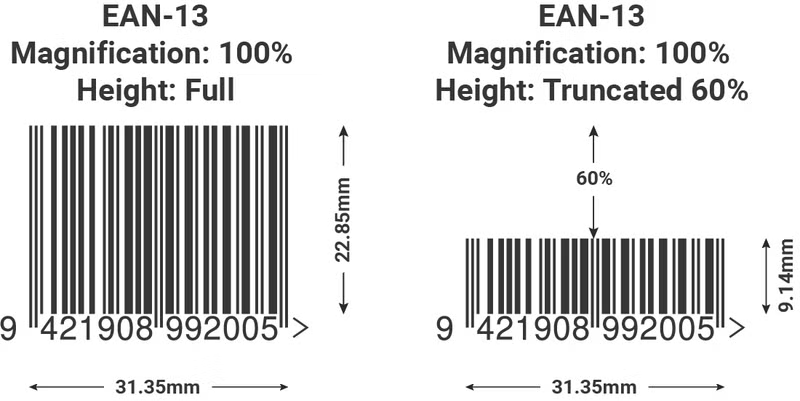
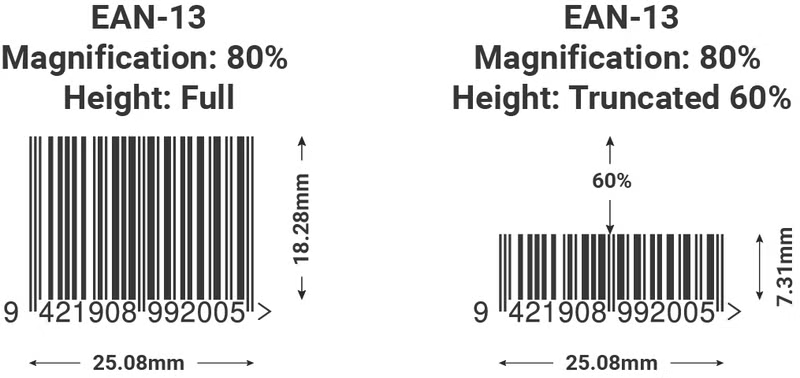
If packaging space is tight, and it is not possible to fit a full-height barcode on a product, there is now an allowance to reduce (truncate) the height of an EAN/UPC barcode graphic used at retail point of sale by up to 60% in certain situations.
Why is this global change happening?
This change has been developed through GS1’s Global Standards Management Process (GSMP), where businesses, industry experts such as solution providers and GS1 member organisations work together to develop and agree global standards in response to real-world business needs. As technical capabilities change, so do GS1 standards to reflect these changing capabilities.
The change recognises that when there is no possibility of printing an EAN/UPC barcode’s bar height at the minimum height for a given x-dimension, a truncated barcode may be used. As truncation can diminish the ability for omnidirectional scanning at point of sale, it should be avoided unless strictly necessary.
When are we adopting this change in New Zealand?
The change has been ratified through the global GS1 standards management process and will be incorporated into the next update of the GS1 General Specifications in January. However, GS1 New Zealand has adopted the change from 16 October 2026 giving GS1 New Zealand members access to the additional flexibility sooner and keeping New Zealand aligned with Australia.
There’s no need to change an existing barcode that’s working well. In fact, a full-height barcode remains the best option wherever you have the space. But if packaging space is at a premium, you now have another option.
Important points to note
This allowance applies only to EAN/UPC barcodes used on products scanned at retail point of sale.
Products that may also be scanned in warehouse, logistics, or general distribution environments should continue to use full-height barcodes in line with existing GS1 guidelines. Often referred to as ‘dual purpose’ products, these are stand-alone items, not packed in outer cartons, that pass through the supply chain as a single entity. Truncation is not permitted for items requiring scanning outside retail point of sale environments.
This change does not apply to other linear barcode types, including GS1 DataBar, ITF-14, or GS1-128.
Wherever possible, GS1 recommends using the full barcode height to support optimal omnidirectional scanning performance at retail checkout.
Truncation should only be used when packaging space is limited.
What does truncation mean?
Truncation simply means reducing the height of a linear barcode relative to its width. While EAN/UPC barcodes can now be reduced within the updated limits, reducing barcode height can affect how easily and efficiently the barcode scans.
That’s why we still recommend designing packaging with a full-height barcode wherever practical and using the new allowance where packaging constraints make it useful.
Example of truncated barcode (100% magnification)
Example of truncated barcode (80% magnification)
Changing your packaging? Get your barcode verified.
If you’re changing the size or placement of a barcode, our Barcode Verification Service is a simple way to check that your barcode will scan and that it meets the GS1 General Specifications before your packaging goes into production.
Our verification team assesses the barcode against GS1 standards and gives you a report identifying any issues that could affect scanning. This can help you catch problems before you commit to a print run, when they’re much easier — and cheaper — to fix!
If you’re unsure whether this change applies to your product, or you’d like advice on barcode sizing, placement or verification, please get in touch with the GS1 New Zealand team.
We’re here to help.